

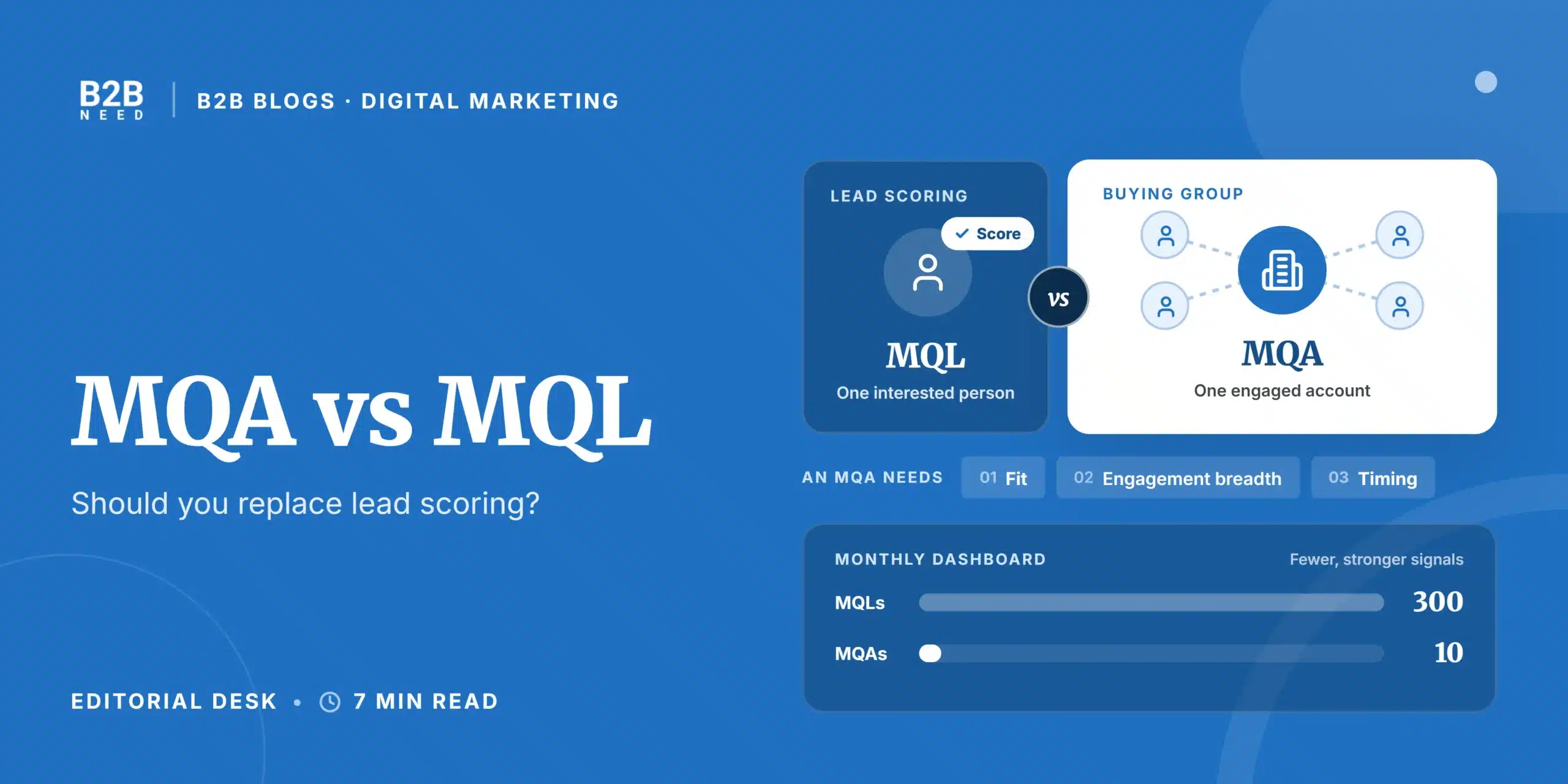
In the MQA vs MQL debate, the starting point matters. For years the marketing qualified lead was the unit that marketing and sales agreed on. A person downloaded an ebook, attended a webinar, opened a few emails, and crossed a score threshold, and sales got a name to call. The model is simple, easy to report, and still in use at most B2B companies. It also measures something that has less and less to do with how companies buy.
Forrester’s 2026 State of Business Buying research describes a typical buying decision involving 13 internal stakeholders and nine external influencers. When a purchase depends on that many people, one person’s interest is weak evidence. So the MQA vs MQL debate is really a question about what you count: individuals or accounts.
| Quick answer: An MQL is a person who has shown enough interest to pass to sales. An MQA is an account that fits your ideal customer profile and shows engagement from several people, often combined with intent data. MQAs suit teams selling larger deals to defined target accounts. MQLs still work for high-volume, lower-priced sales with short cycles. Many teams run both, with MQAs for target accounts and MQLs for inbound. |
MQA vs MQL: the core difference
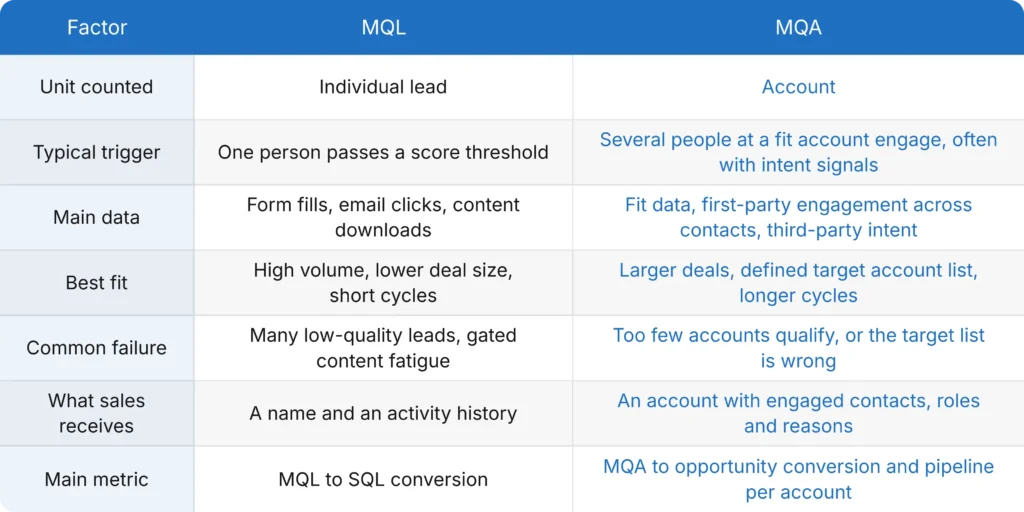
An MQL answers, “Is this person interested?” An MQA answers, “Is this company in a buying cycle, and are the right people involved?” The difference changes what marketing optimizes for. A team measured on MQLs is rewarded for more form fills. A team measured on MQAs is rewarded for engaging more of the right people at the right accounts.
Why MQLs break for account-based teams
Most teams weighing MQA vs MQL are not unhappy with lead scoring in general. They are unhappy with what it produces at their best accounts.
MQL programs have three known weaknesses when deals involve buying groups:
- They reward the wrong behavior. Gating content to collect form fills creates MQLs from students, competitors, and job seekers alongside real buyers.
- They split one buying signal into many. Five people from the same account researching you look like five weak leads instead of one strong account.
- They miss research that happens out of sight. Our analysis of the B2B buying process shows how much early research now happens in AI search tools, where no form is filled.
When MQLs still make sense
Do not throw out lead scoring because it is unfashionable. MQLs remain useful when deals are small and fast, when one person often decides alone, when you sell to a broad market rather than a named account list, or when inbound volume is high and sales needs a way to prioritize it. Product-led companies often combine product usage with MQL-style scoring, which is closer to a product qualified lead model.
The honest answer for most mid-size B2B companies is a hybrid: MQ. As for the few hundred accounts sales has named as targets, and a lighter MQL process for inbound interest from everyone else. The two models can share the same scoring data; what changes is the unit you report and the team that acts on it.
What makes an account an MQA?
An MQA needs three things at the same time:
- Fit: the account matches your ideal customer profile on industry, size, region, and technology.
- Engagement breadth: several people at the account have engaged with you within a set window, ideally from more than one function.
- Timing: there is evidence of current activity, such as high-intent page visits, third-party intent surges, or replies to outreach.
A practical starting definition: an account in your target list with at least three engaged contacts in 30 days, at least one visit to a pricing, comparison, or demo page, and fit criteria met. Tune it from there. For a detailed scoring sheet with weights and decay, see our sister site’s guide to intent data scoring.
A 90-day plan for moving to MQAs
Days 1 to 30: agree on the foundations
- Agree the ideal customer profile and target account list with sales leadership.
- Make sure every contact in the CRM is linked to the right account, because MQAs depend on account matching.
- Write the first MQA definition and the service level for how fast sales act on one.
- Keep MQL reporting running in parallel so nobody loses visibility.
Days 31 to 60: run both models side by side.
- Score accounts daily and flag MQ As in the CRM, with the reasons visible.
- Route MQAs to account owners and keep routing inbound MQLs from non-target accounts as before.
- Track MQA to meeting and MQA to opportunity conversion each week.
- Hold a weekly review with sales to check whether flagged accounts are real.
Days 61 to 90: Decide and adjust.
- Compare opportunity creation from MQAs with opportunities from MQLs at target accounts.
- Adjust thresholds so the number of MQAs matches what sales can work.
- Move marketing goals for target accounts from MQL volume to MQA and pipeline numbers.
- Keep MQLs for inbound outside the target list if they still produce pipeline.
What sales does an MQA make?
An MQA is only useful if sales knows what to do when one arrives. Agree on a short play with the sales team before launch:
- Review the reasons shown on the account: which people engaged, with what, and which intent topics are active.
- Check for existing relationships, open opportunities, or past deals before reaching out.
- Reach out to two or three people in different roles, not only the most active contact. The most active person is often a researcher, not the decision maker.
- Use the engagement as context, not as a script. Refer to the problem the account is researching, not to the fact that someone visited your pricing page.
- Log the outcome on the account within the service level, including when the MQA was not real and why.
That last step matters most. Feedback on false MQ As is how the definition improves, and it is the step most teams forget after the first month.
Who owns the MQA model?
Marketing operations usually owns the scoring logic and the account matching. Sales leadership owns the target account list together with marketing and agrees on the service level. Revenue operations owns the reporting, so both teams see the same numbers. If one team owns everything, the other will not trust it, and the MQA vs MQL switch stalls.
How reporting changes
The biggest change in an MQA model is what the leadership dashboard shows. Replace MQL volume with:
- Target accounts reached and engaged
- Number of MQAs and MQA to opportunity conversion
- Average engaged contacts per opportunity
- Pipeline and win rate at target accounts
- Sales cycle length for MQA-sourced opportunities
Expect the headline number to look smaller. Ten MQAs a month may replace 300 MQLs. That is the point: fewer, better signals that sales take seriously. Our B2B demand generation playbook covers how to set these goals during 2027 planning.
Mistakes to avoid when switching
- Switching off MQLs before MQAs prove themselves, which leaves a pipeline gap.
- Building MQAs on poor account matching, so engagement lands on the wrong records.
- Making the threshold so strict that almost no accounts qualify.
- Changing the model without changing marketing’s goals, so the team keeps chasing form fills.
- Forgetting that buyers form shortlists early. Being known before the account surges matters, as our research on the B2B buyer shortlist explains.
FAQs:
What is the difference between an MQA and an MQL?
An MQL is one person who has shown enough interest to pass to sales. An MQA is an account that fits your ideal customer profile and shows engagement from several people, often with intent signals.
What does MQA stand for?
Marketing qualified account.
Should we replace MQLs with MQAs?
Replace them for target accounts where deals are large and involve buying groups. Keep MQLs where deals are small, fast, and decided by one person.
How many contacts should engage before an account becomes an MQA?
Many teams start with three engaged contacts in 30 days plus a high-intent action, then adjust based on conversion to opportunities.
Do MQAs need intent data?
Not always. First-party engagement across several contacts can define an MQA, but third-party intent helps spot accounts researching before they engage with you.
How do you measure an MQA program?
Track MQA to opportunity conversion, engaged contacts per opportunity, pipeline and win rate at target accounts, and sales cycle length.