

Every sales technology vendor seems to be using the word “agentic” now.
But there is an important difference between an AI tool that helps a salesperson complete a task and an AI agent that can manage a workflow, make decisions, use multiple systems, and take action with limited human intervention.
That difference matters.
Agentic AI in B2B sales is not simply a better way to write emails, summarize calls, or suggest the next prospect. Those are useful applications of AI, but they do not necessarily make a system agentic.
A sales rep using AI to draft an email is still making the decisions.
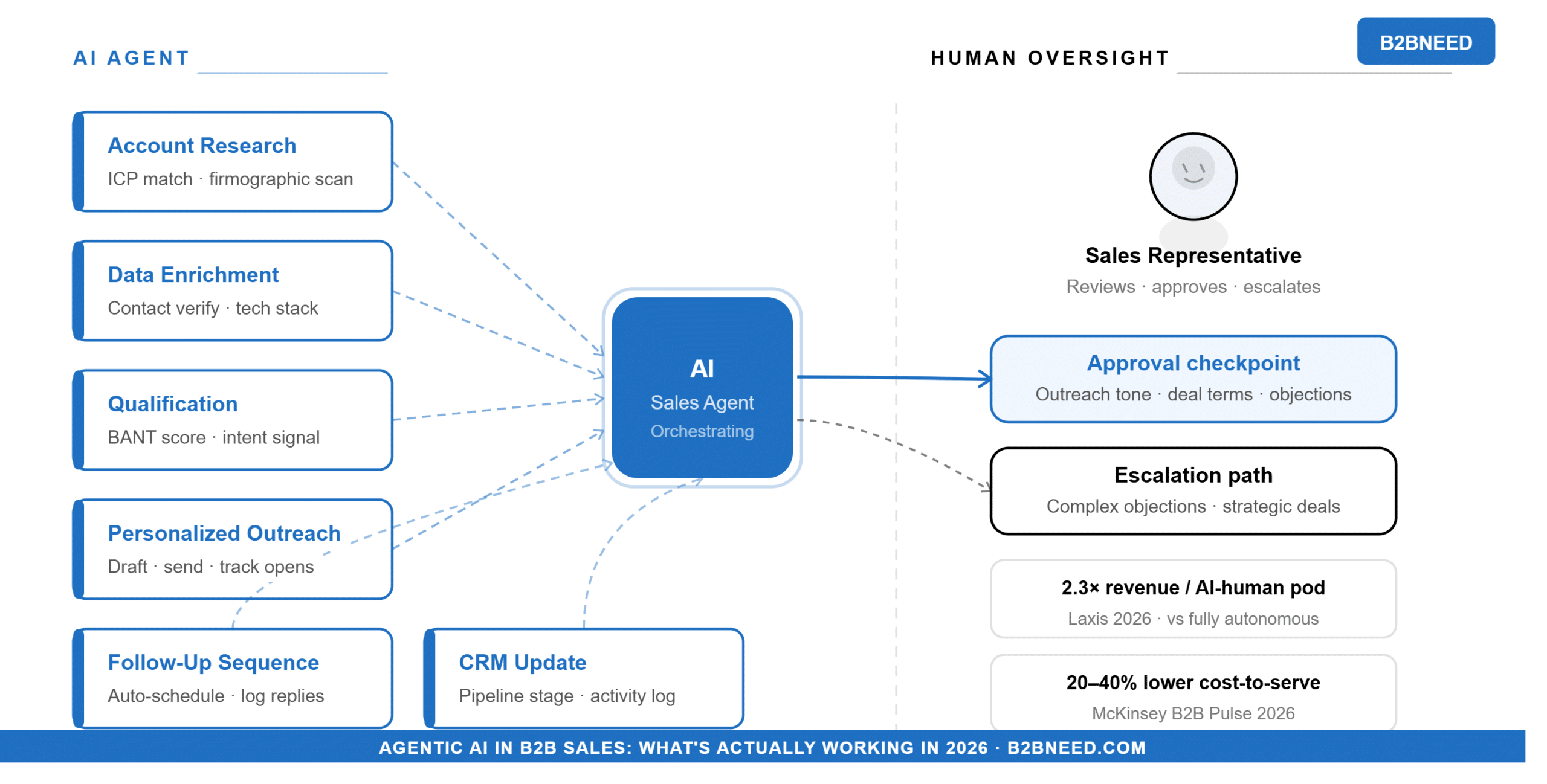
An AI agent might research an account, identify relevant buying signals, decide which prospects meet a set of criteria, update the CRM, prepare personalized outreach, and trigger the next step in the workflow based on what it finds.
The technology is doing more than generating an answer. It is carrying out a process.
That distinction is becoming commercially important.
Salesforce’s 2026 State of Sales report found that 54% of sales organizations have used AI agents, while 34% expect to adopt them within the next two years. Salesforce also found that 92% of sellers with AI agents say the technology benefits their prospecting efforts.
But adoption alone does not tell us whether companies are getting meaningful business value.
McKinsey’s 2026 B2B Pulse Survey points to what is possible when companies redesign workflows around agentic AI rather than simply adding AI features to existing processes. In financial services, companies that rewired prospecting and relationship-management workflows with agentic AI achieved 3% to 15% higher revenue per relationship manager and 20% to 40% lower cost to serve in McKinsey’s experience.
The lesson is not that every sales team needs an autonomous AI workforce.
It is that the value of AI depends heavily on what you ask it to do.
If AI only helps a salesperson complete individual tasks, the gains may be incremental.
If it can manage a well-defined sales workflow from one step to the next, the potential is much larger.
That is where agentic AI in B2B sales becomes a different category of technology.
And before investing in it, sales leaders need to understand exactly where that line is.
What “Agentic” Actually Means in B2B Sales
An agentic AI in B2B sales workflow gives an AI system a defined objective and enough authority to complete multiple steps toward that objective.
It does not simply draft an email.
For example, an agent could identify accounts that match a target profile, research recent company activity, evaluate relevant buying signals, prepare personalized outreach, send the message within predefined rules, monitor the response, and determine whether the next step should be another automated action or a human handoff.
The salesperson is not approving every individual step. They define the objective, rules, permissions, and escalation points. The AI manages the workflow within those boundaries.
That is different from AI-assisted sales.
With an AI-assisted tool, a rep might ask AI to write an email, summarize a sales call, research an account, or suggest a lead score. The technology helps the rep complete a task, but the rep still decides what happens next and initiates the action.
Both approaches have value. The difference is who controls the workflow.
With AI assistance, the human remains in control of each action.
With agentic AI, the human delegates a defined process to the system and supervises the result.
A practical maturity model for agentic AI in B2B sales
There is no single industry-standard four-level model for measuring agentic sales maturity. But the following framework is useful for understanding the progression from AI assistance to autonomous workflow execution.
| L1 | AI-Assisted (most teams are here) Reps use AI for individual tasks such as email drafting, call summaries, account research, lead scoring, and CRM updates. The human initiates and approves each action. |
| L2 | AI-Automated (reaching this requires data foundations) Defined, repetitive tasks run automatically. Examples include data enrichment, lead routing, list building, follow-up reminders, and basic nurture sequences. Humans remain responsible for the workflow and its outcomes. |
| L3 | AI-Orchestrated (where the revenue lift starts appearing) AI coordinates several steps across systems. It can identify a target account, gather information, enrich the record, assign the account, prepare outreach, trigger the next step, and update the CRM based on what happens. Humans handle exceptions and important decisions. |
| L4 | Fully Agentic (fewer than 1 in 5 enterprise teams) AI operates a broader revenue workflow against a defined objective. It can evaluate changing information, make decisions within approved parameters, take actions across systems, and escalate situations that fall outside its authority. Humans provide strategy, permissions, and oversight rather than approving every step. |
The distinction between these levels matters because automation and agency are not interchangeable terms.
An automated workflow follows predefined rules.
An agentic system has more room to interpret context, make decisions, select the next action, and respond to what happens during the workflow.
That does not mean every sales process should be fully autonomous.
In fact, many sales activities should remain human-led. Pricing exceptions, complex negotiations, sensitive customer situations, and major commercial commitments often require judgment that businesses may not want to delegate.
The practical opportunity is to identify the parts of the revenue process where AI can operate safely without requiring a person to approve every step.
That is also where the infrastructure becomes important.
Gartner’s 2026 research warns that simply adding more AI agents will not automatically improve sales productivity. Gartner predicts that by 2028, AI agents will outnumber human sellers by 10 to 1, while fewer than 40% of sellers will say those agents improved their productivity. Gartner points to data quality, workflow integration, and seller experience as key factors in determining whether agents actually create value.
The buyer side makes this even more important.
Gartner predicts that by 2028, 90% of B2B buying will be AI-agent intermediated, with more than $15 trillion in B2B spending flowing through AI-agent exchanges.
That does not mean human buyers disappear or that every purchase becomes fully autonomous.
It means sellers need to prepare for a buying process in which AI systems increasingly help identify vendors, compare options, gather information, and execute parts of the purchasing process.
For sales organizations, the question is therefore becoming more specific:
Can your systems provide the data, context, permissions, and workflows an AI agent needs to take useful action?
If the answer is no, adding another AI feature will not solve the problem.
What AI Agents Actually Do in B2B Sales: The Honest Picture
The strongest case for agentic AI in B2B sales is not that it can do everything a salesperson does.
It is that it can handle a large number of repetitive actions without requiring a salesperson to initiate each one.
That distinction matters because more automation does not automatically produce better sales results.
Laxis’ 2026 research illustrates the point. In one controlled comparison cited in its State of the AI SDR 2026 report, an AI-only setup booked 847 meetings with an 11% conversion rate, while a hybrid human-plus-AI setup booked 312 meetings with a 38% conversion rate. Laxis reports that the hybrid configuration generated roughly 2.3 times more revenue despite producing fewer meetings.
The lesson is simple: meeting volume is not the same as pipeline quality.
AI is particularly well suited to sales tasks that are bounded, repetitive, high-volume, and time-sensitive. Humans remain important when the work depends on context, judgment, relationships, or information that is difficult to capture in structured data.
Consider what happens when a promising deal starts to stall.
An AI system can identify that response times have increased, detect a change in engagement, flag missing stakeholders, or surface an objection from previous conversations.
But deciding why the buyer has lost momentum and how to recover the relationship can still require a salesperson who understands the account.
The practical question is therefore not, “Can AI do this task?”
It is, “How much of this task can AI safely own?”
Where AI Agents Fit Across the Sales Process
| Sales Task | AI can handle independently | Human involvement | Expected role of AI |
| Lead list building and enrichment | Yes, within defined criteria | Oversight | Find, validate, enrich, and prioritize records at scale |
| First-touch personalization | Partially | Review for important accounts | Research the account and generate relevant messaging |
| Follow-up execution | Yes, within approved rules | Exception handling | Trigger and manage follow-ups based on responses and timing |
| Meeting scheduling and confirmation | Yes | Usually not required | Coordinate calendars, confirmations, reminders, and updates |
| Live objection handling | Limited | Critical | Surface relevant information or suggested responses while the human leads |
| Deal qualification | Partially | Critical for important opportunities | Score signals and recommend qualification; human validates the opportunity |
| Proposal and pricing generation | Partially | Required for significant deals | Assemble proposals and pricing options within approved parameters |
| Renewal risk identification | Yes for signal detection | Critical for response strategy | Detect usage, engagement, support, and commercial risk signals |
The pattern is clear.
AI is strongest when the process has a defined objective, reliable data, clear rules, and a measurable outcome.
Human judgment becomes more important as the cost of being wrong increases.
That makes the best near-term use of agentic AI less about creating a completely autonomous sales organization and more about delegating the right parts of the workflow.
An agent can build and enrich a prospect list while a salesperson focuses on account strategy.
It can monitor responses and execute follow-ups while the rep prepares for a live conversation.
It can identify renewal risk while the account manager decides how to approach the customer.
It can keep the CRM updated while the salesperson spends less time on administrative work.
The human does not disappear from the process. The human spends more time where judgment has commercial value.
The ROI Case Is About Task Allocation
This is also why the most useful way to measure agentic AI is not the number of emails sent, records processed, or meetings booked.
Those metrics measure activity.
Revenue teams need to measure what happens further down the funnel:
- Qualified opportunities created
- Opportunity-to-win conversion
- Revenue per seller
- Sales cycle length
- Cost per qualified opportunity
- Rep time spent on selling activities
- Pipeline generated from AI-assisted workflows
- Revenue influenced by automated workflows
Laxis’ 2026 research makes this distinction particularly important. Its findings suggest that an autonomous system can produce substantially more activity without producing proportionally better commercial outcomes. The hybrid model performed better because AI handled scale while humans remained responsible for quality and relationship management.
There is also broader evidence that the value comes from how salespeople work with AI, rather than simply whether a company owns AI software.
Gartner found that B2B sellers who effectively partner with AI tools were 3.7 times more likely to meet quota than sellers who did not. The research surveyed 1,026 B2B sellers in early 2024.
Salesforce’s 2026 sales research cites the same finding and reports that sellers using AI and agents can spend more time on higher-value customer work.
That leads to a more useful definition of agentic AI ROI:
The goal is not to remove humans from the sales process. The goal is to remove unnecessary human involvement from the parts of the process that do not require human judgment.
That is where agentic AI in B2B sales has the strongest practical case today.
The Data Foundation Problem
The biggest barrier to agentic AI in B2B sales is often not the AI. It is the data behind it.
IBM’s 2025-2026 State of Salesforce research found that poor data availability and quality was the leading barrier to agentic AI adoption, cited by 53% of Salesforce customers. Only 26% said their customer data primarily lived within Salesforce, leaving critical information spread across other systems.
That matters because an AI agent can only make decisions from the information it can access.
A prospecting agent needs accurate account and contact data. A follow-up agent needs reliable engagement and CRM activity. A renewal agent needs access to product usage and customer history.
Better AI cannot compensate for missing business context.
McKinsey’s 2026 B2B research also points to the importance of redesigning workflows and connecting data when deploying agentic AI. In its experience, financial-services companies that rewired prospecting and relationship-management workflows achieved 3% to 15% higher revenue per relationship manager and 20% to 40% lower cost to serve. These figures are specific to McKinsey’s financial-services experience, not a universal B2B benchmark.
The practical lesson is simple: do not put an autonomous agent on top of a broken sales process. Fix the data and workflow first.
The Four-Stage Path to Agentic Sales AI
There is no universal maturity model for agentic sales. But a practical implementation path looks like this:
1. Start With Task Clarity
Identify repetitive work that consumes seller time without requiring much judgment.
Research, data entry, scheduling, enrichment, and basic follow-up are good starting points.
Measure seller time returned, not the number of tasks automated.
2. Build the Data Foundation
Before giving AI more authority, make sure the underlying data is reliable.
Check CRM completeness, duplicate records, account and contact accuracy, data freshness, intent signals, product information, and system integrations.
The standard should be simple: the data used by the agent must be reliable enough for the decisions it is allowed to make.
3. Connect the Workflow
Once the data is reliable, connect individual tasks into a complete workflow.
Intent signal → account identification → enrichment → qualification → rep assignment → personalized outreach → follow-up → CRM update
The objective is not maximum automation. It is removing unnecessary manual steps while keeping human review where judgment matters.
4. Deploy Agents with Guardrails
Give agents authority only over clearly defined processes.
Set:
- What the agent can do
- What requires human approval
- When it must escalate
- What success looks like
- How actions are logged and reviewed
Start with bounded workflows, measure the results, and expand the agent’s authority only when the quality holds.
The progression is straightforward:
Assist the seller → automate repetitive tasks → orchestrate workflows → delegate defined processes to agents.
The agent is the execution layer. It is not a replacement for good data, sound sales strategy, or a well-designed operating process.
Readiness Check Before Deploying Agentic AI
Before investing in an agentic AI platform, check whether the sales operation is ready to support it.
| Readiness Condition | In Place? |
| CRM data completeness above 85% (required fields populated for active accounts) | ☐ Yes / ☐ No |
| Contact data verified or enriched in the past 90 days for target accounts | ☐ Yes / ☐ No |
| Clear ICP definition agreed between marketing and sales (not just firmographic — behavioral and intent-based) | ☐ Yes / ☐ No |
| Sales process documented with specific handoff criteria (MQL definition, SQL criteria, escalation triggers) | ☐ Yes / ☐ No |
| Existing rep time audit completed — know which tasks consume most non-selling time before automating | ☐ Yes / ☐ No |
| Agent exception-escalation rules defined — know what the AI handles independently vs what requires human approval | ☐ Yes / ☐ No |
If several of these are missing, deploying an agent will likely automate the existing process without fixing its underlying problems.Fix the data, process, and governance gaps first. Then give the agent authority to execute.
The Productivity Gap Is Already Forming
The agentic AI in B2B sales divide in 2026 is not simply about who has AI and who does not. Salesforce reports that 54% of sales organizations have already used AI agents. The bigger difference is how deeply those systems are connected to actual sales workflows.
The companies getting meaningful value are not using AI just to generate emails, summarize calls, or automate isolated tasks. They are connecting data, workflows, and AI execution around specific commercial outcomes.
McKinsey’s 2026 research shows what that can look like. In its experience with financial-services companies, organizations that rewired prospecting and relationship-management workflows around agentic AI achieved 3% to 15% higher revenue per relationship manager and 20% to 40% lower cost to serve.
The path forward is straightforward:
Fix the data foundation. Build connected workflows. Deploy agents on bounded tasks. Keep human judgment where it matters. Measure commercial outcomes, not activity. Expand autonomy only when performance proves it is safe and valuable. The competitive advantage will not come from simply having more AI. It will come from building sales processes that use it well.
What is agentic AI in B2B sales?
Agentic AI in B2B sales refers to AI systems that can manage and execute multi-step sales workflows with limited human intervention. An agent might research an account, identify buying signals, personalize outreach, schedule follow-ups, update the CRM, and escalate exceptions to a salesperson.
The key difference from AI-assisted tools is that the agent can execute a defined workflow rather than simply help a salesperson complete individual task.
What ROI does agentic AI produce in B2B sales?
The results depend heavily on the workflow, data quality, and level of implementation. McKinsey’s 2026 B2B research cites financial-services companies that achieved 3% to 15% higher revenue per relationship manager and 20% to 40% lower cost to serve after redesigning prospecting and relationship-management workflows around agentic AI.
These figures should be treated as an example of potential impact, not a universal B2B benchmark.
What tasks should AI agents handle in B2B sales?
AI agents are best suited to repetitive, high-volume, and time-sensitive work such as lead enrichment, follow-up execution, scheduling, CRM updates, account research, and renewal-risk monitoring.
Human involvement remains important for complex qualification, objection handling, pricing, negotiations, and situations where relationship context matters.
How many B2B sales teams are using AI agents in 2026?
Salesforce’s 2026 State of Sales report found that 54% of sales organizations have used AI agents, while 34% expect to adopt them within the next two years.
However, adoption does not necessarily mean fully autonomous sales workflows. Many organizations are still using AI for individual tasks or defined automation rather than giving agents broad control over multi-step processes.
What is the most common reason AI sales agent programs fail?
Poor data quality is one of the biggest barriers. IBM’s 2025-2026 State of Salesforce research found poor data availability and quality was the leading barrier to agentic AI adoption, cited by 53% of respondents.
Agents need accurate account, contact, engagement, product, and CRM data to make reliable decisions. If the underlying process or data is weak, AI will automate the problem rather than solve it.