

At some point over the past 18 months, B2B buying changed in a way most sales and marketing teams have not fully caught up with.
Not gradually. Structurally.
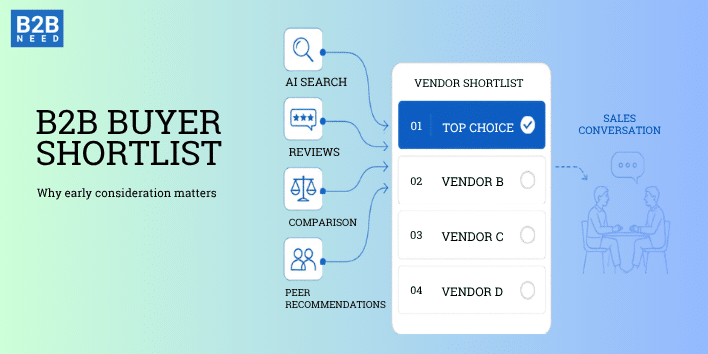
The change is this: buyers are now forming a B2B buyer shortlist before they ever speak to a vendor.
They are using AI tools such as ChatGPT, Perplexity, and Google AI Overviews to research categories, understand their options, compare vendors, and narrow their choices down to two or three companies.
By the time an SDR sends the first outreach email, the buyer may already know which vendors are worth considering.
The data backs this up.
According to 6sense’s 2025 Buyer Experience Report, which analyzed more than 4,500 B2B purchases, 95% of buyers choose a vendor that was already on their Day One shortlist. That shortlist is formed before the buyer engages with sales. Even more striking, the vendor ranked first on that initial shortlist wins roughly 80% of the time.
That changes how sales and marketing teams need to think about the B2B buying process.
If you still measure marketing primarily by MQL volume and sales by outbound touches, you may be measuring activity that happens after the buyer has already narrowed down their options.
The bigger battle is happening earlier.
It happens when a buyer searches for a solution, asks an AI tool for recommendations, compares vendors, reads reviews, evaluates alternatives, and decides which companies deserve a closer look.
The question is no longer simply whether your sales team can reach the buyer.
It is whether your company makes the B2B buyer shortlist in the first place.
Because if you are not on that shortlist, your sales team may never get the opportunity to make the pitch.
| 95% of B2B deals go to a vendor already on the buyer’s Day One shortlist — before any sales contact (6sense, 2025) |
What Has Actually Changed
The B2B buying process did not suddenly disappear. It reorganized.
For years, buyers have been doing more research on their own. But AI has accelerated that shift. Tools such as ChatGPT and Perplexity can now help buyers research a category, compare vendors, summarize reviews, identify differences between solutions, and narrow down their options in minutes.
That has changed where the B2B buyer shortlist is formed.
It is increasingly happening before a buyer ever speaks with sales.
The latest 6sense research shows just how early vendor preferences are established. In its 2025 Buyer Experience Report, buyers evaluated an average of 5.1 vendors, while 3.6 vendors were already on the shortlist on Day One. Buyers ultimately purchased from that initial shortlist 95% of the time. In other words, most of the vendors that make the final consideration set are already there when the buying process begins.
That makes the first position on the B2B buyer shortlist extremely valuable. It is much harder to win a deal when your company is not being considered at the start.
The buying process now looks very different from the traditional model:
| Phase | Old Model (pre-2024) | New Reality (2026) |
| Research | Buyer visits vendor websites, reads content, downloads reports, and speaks with sales to learn about available solutions. | Buyer uses search engines, AI tools, communities, reviews, and peer recommendations to research the category before contacting vendors. |
| Shortlisting | Marketing and sales help introduce vendors and influence which companies make the consideration set. | Much of the B2B buyer shortlist is formed before any seller interaction. |
| Sales engagement | The first sales conversation is often exploratory. The buyer is still learning about the problem and available solutions. | The buyer arrives with requirements, preferences, and competing vendors already in mind. |
| Evaluation | Vendors spend time educating the buyer, running demos, answering basic questions, and establishing credibility. | Vendors are increasingly asked to validate claims, demonstrate fit, address risks, and prove why they should win. |
| Decision | Multiple conversations gradually shape the buyer’s preference. | The buying group enters vendor conversations with a stronger view of which options deserve serious consideration. |
This does not mean buyers are doing less research.
They are doing more of it, but with better tools.
6sense found that buyers evaluated slightly more vendors in 2025 than in previous years, while the average buying cycle became shorter, falling from 11.3 months in 2024 to 10.1 months in 2025. At the same time, buyers began contacting sellers earlier in the journey, moving from about 69% of the way through the journey to 61%.
The important point is that earlier seller contact does not mean sellers have regained control of the buying process.
Buyers still do much of the work before the first conversation. In 2025, 94% of buying groups said they had ranked their shortlist in order of preference before engaging with sellers. The vendor ranked first during the selection phase went on to win the deal about 80% of the time.
So, the role of the first sales conversation has changed.
It is less about creating demand from scratch and more about validating a decision the buying group has already started to form.
That distinction matters because B2B buying rarely involves one person making a decision alone. Forrester’s 2026 State of Business Buying research found that the typical B2B purchase involves 13 internal stakeholders and nine external participants. For more complex or strategic purchases, the buying group can be even larger.
By the time a vendor enters the conversation, those stakeholders may already have shared information, compared options, discussed risks, and developed preferences.
The implication for go-to-market teams is straightforward:
You cannot rely on sales conversations to create consideration if you were never considered in the first place.
The battle starts earlier, when buyers are researching the category and deciding which vendors belong on the B2B buyer shortlist.
That is where visibility, brand familiarity, useful content, third-party validation, customer proof, and presence in AI-assisted research start to matter.
And that is why the new question for B2B marketing is not simply, “How many leads did we generate?”
It is:
“When our ideal buyers start researching, do we make their shortlist?”
| 2.5 Average B2B vendor shortlist length in 2026, down from 3.2 in recent years (Apollo, 2026) — fewer slots, higher stakes |
AI Search Is Now the Discovery Layer
To understand where the B2B buyer shortlist comes from, you first need to understand where buyers are starting their research.
That starting point is changing fast.
G2’s 2026 research found that 51% of B2B software buyers now start their research with an AI chatbot more often than Google. Overall, 71% use AI chatbots at some point during the software research process.
The shift is even more pronounced among B2B SaaS marketing leaders. Wynter’s 2026 research, based on a survey of 101 mid-market B2B SaaS CMOs, found that 84% use AI and large language models such as ChatGPT, Claude, and Perplexity for vendor discovery. Sixty-eight percent said they now start their searches with AI tools before traditional search engines.
This is more than a change in search behavior. It is a change in how buyers discover vendors.
Traditional SEO was built around ranking web pages in search results. A buyer searched for a problem, reviewed the results, visited several websites, and decided which companies were worth exploring.
AI search compresses much of that process.
A buyer can now ask an AI tool to recommend vendors, explain the differences between them, compare alternatives, identify the best options for a specific use case, or build an initial B2B buyer shortlist.
The AI answer may draw from many different sources, including vendor websites, review platforms, industry publications, analyst research, customer discussions, comparison pages, and other publicly available information. The buyer gets a synthesis rather than a list of links.
That changes what visibility means.
A company can rank well for its target keywords and still be missing from the conversation a buyer is having with an AI tool.
The reverse can also happen. A company with less traditional search visibility can appear in an AI-generated recommendation because it has strong third-party reviews, relevant customer evidence, consistent positioning across multiple sources, or a clear presence in the places AI systems use to understand a category.
G2’s 2026 research shows how important this has become. AI chatbots were cited by 54% of surveyed buyers as a source influencing which vendors made their shortlists, ahead of software review sites at 43%, market research firms at 36%, vendor websites at 36%, and peers and colleagues at 33%.
But AI does not create these recommendations from nowhere.
It needs information to work with.
That means the way your company is represented across the wider B2B information ecosystem matters more than it used to. Reviews, customer stories, comparison pages, analyst coverage, industry publications, community discussions, product documentation, and clear category positioning all contribute to the information available when buyers or AI systems research your company.
Consistency matters, too.
If your website says one thing, your review profiles suggest another, and independent sources describe your product differently, buyers have more reason to question what is accurate. If the same clear positioning and evidence appear across multiple credible sources, it becomes easier for both buyers and AI systems to understand what you do, who you serve, and where you fit.
This is why AI search should not be treated as simply another SEO channel.
The goal is not only to rank for a keyword. It is to be understood, mentioned, compared, and recommended when your buyers ask who they should consider.
That is the new discovery layer.
And because discovery increasingly shapes the B2B buyer shortlist, AI visibility is becoming part of the competitive landscape long before a buyer fills out a form or books a sales call.
Three Implications for B2B Revenue Teams
1. Marketing’s job now starts before lead capture
If 95% of buyers purchase from a vendor that was already on their Day One shortlist, then a significant part of marketing’s impact happens before a buyer fills out a form, downloads a report, or speaks with sales.
This is not the same as traditional top-of-funnel awareness.
Buyers are no longer simply becoming familiar with a category or a brand during this early stage. They are researching vendors, comparing alternatives, reading reviews, evaluating capabilities, and deciding which companies are worth considering.
That means form fills and MQLs capture only one part of marketing’s impact.
A better question is:
How often does our company appear when buyers who fit our ICP research the problem we solve?
Answering that requires looking beyond conversion rates and lead volume. Teams need to understand whether they are visible in AI search, present in the communities their buyers trust, mentioned by credible third parties, reviewed on relevant platforms, and consistently positioned across the sources buyers use during research.
The goal is not to eliminate lead capture. It is to recognize that lead capture happens after an important part of the buying decision has already taken place.
2. Content that builds authority matters more than content built for clicks
When buyers use AI tools to research vendors, the quality and breadth of the information available about a company matter.
AI systems can draw on vendor websites, review platforms, industry publications, analyst research, customer stories, community discussions, and other sources when generating answers and recommendations.
That makes the type of content you publish more important than simply how much content you publish.
Original research, proprietary data, detailed customer case studies, strong expert analysis, product comparisons, and useful perspectives based on real customer experience give buyers something they cannot get from another generic blog post.
Generic thought leadership still has a place, but content built around broad statements such as “five things every marketer should know” is unlikely to differentiate a company on its own.
The better question is:
What can we publish that gives buyers information they cannot easily get anywhere else?
That might be original research from your customer base. It might be a detailed case study with measurable results. It might be an expert analysis of a problem your market consistently gets wrong. It might be data that helps buyers make a better decision, whether or not they ultimately choose your product.
This does not mean publishing more.
It means creating fewer pieces that are more useful, more specific, and more credible.
3. Peer credibility can have more influence than cold outreach
Buyers do not rely only on vendor-controlled channels when researching solutions. They also look to peers, communities, review platforms, analysts, and other independent sources for evidence that a vendor is worth considering.
Wynter’s 2026 research found that 65% of surveyed B2B SaaS CMOs use peer communities when searching for vendors, while 42% ranked word of mouth as their top influence on vendor discovery. Only 2% ranked cold outreach as their top influence. (Wynter)
The gap is significant.
It does not mean outbound is dead. It means outbound operates differently from channels that build familiarity and credibility before the sales conversation.
A recommendation from a trusted peer can put a company on the B2B buyer shortlist before the vendor knows an account is researching. A cold email, by contrast, asks for attention from a buyer who may already have a shortlist.
That makes peer credibility a valuable part of modern go-to-market strategy.
Reviews on platforms such as G2 and Capterra matter. So do customer recommendations, practitioner discussions, community conversations, analyst mentions, and credible third-party coverage.
For sales teams, the implication is not to abandon outbound. It is to make outbound more relevant.
Instead of treating every ICP-fit account as equally ready for outreach, teams can prioritize accounts showing signs of active research or buying intent. When a company is already evaluating a problem your product solves, sales have a much better opportunity to influence the decision.
The timing matters.
Outbound works best when it meets an active buying process, not when it tries to create one from nothing.
The broader lesson for revenue teams is straightforward: marketing and sales cannot afford to think of the buyer journey as beginning with the first form fill or sales touch.
It often begins much earlier, when a buyer starts asking:
Who should we consider?
And increasingly, the companies that make that first B2B buyer shortlist have a significant head start.
| 80% of buyers choose the vendor ranked first on their shortlist, according to 6sense’s 2025 Buyer Experience Report. |
What to Actually Do About It
You do not need to rebuild your entire go-to-market strategy. But you do need to pay more attention to what happens before a buyer enters your funnel.
If buyers are researching vendors, comparing options, and building a B2B buyer shortlist before they contact sales, your company needs to be visible and credible during that part of the process.
Here are five things to focus on.
1. Audit your AI visibility
Start by asking the AI tools your buyers are likely to use the same questions they would ask during vendor research.
For example:
“What are the best [category] vendors for [ICP industry]?”
Then make the questions more specific:
“What are the best [category] platforms for a company in [specific industry]?”
“Compare the leading [category] vendors for [specific use case].”
“What should a [buyer role] look for when choosing a [category] vendor?”
Run these searches across ChatGPT, Perplexity, Claude, and other AI search tools that matter in your market.
Look at which companies appear, how they are described, which vendors are recommended, and what sources are used to support the answers.
Do not treat one search as a definitive ranking. AI responses can vary depending on the prompt, model, location, and when the search is performed.
The purpose is to establish a baseline.
If your company rarely appears when your target buyers ask these questions, you have a visibility problem. Find out why before assuming you need more leads.
Run the audit regularly and track what changes.
2. Build review and third-party credibility before you need it
Buyers do not rely only on vendor websites. They look at review platforms, customer stories, analyst research, industry publications, communities, and recommendations from people they trust.
That makes third-party credibility an important part of getting onto the B2B buyer shortlist.
Platforms such as G2, Capterra, and Gartner Peer Insights give buyers another way to evaluate your company. But reviews should not be treated as a one-time marketing campaign.
Build a regular process for asking customers for honest feedback, responding to reviews, looking for recurring themes, and sharing those insights with your product and customer teams.
The goal is not to collect perfect reviews.
It is to build enough real customer evidence for a buyer to answer a basic question:
“Do companies like mine trust this vendor?”
That answer can carry more weight than another page of claims on your own website.
3. Create content with something specific to say
Publishing more content will not automatically make your company easier to find or more credible.
Give buyers information they can actually use.
That could be original research, benchmark data, detailed customer results, product comparisons, expert analysis, or lessons based on real customer experience.
Take case studies as an example. “Our customer improved efficiency” tells a buyer very little. A useful case study explains what the customer was trying to solve, what they changed, what happened, and what results they achieved.
Then take that expertise beyond your own website.
Publish in the places your ICP already reads and participates in, including relevant industry publications, communities, research platforms, and professional networks.
Your blog is one distribution channel. It should not be the only one.
The standard is simple:
Create something worth referring to, not something designed only to get a click.
4. Use intent signals to improve outbound timing
Outbound still matters. The problem is that an account matching your ICP is not necessarily ready to buy.
Starting a sales sequence simply because an account fits your target profile does not mean the buyer is researching your category or has a reason to respond.
ABM and intent data can help sales teams identify accounts that are showing signs of active research or evaluation.
Use those signals to decide where sales should spend its time.
The question should not be only:
“Does this account fit our ICP?”
It should also be:
“Is this account showing signs that it is looking for a solution we provide?”
That does not mean waiting for a perfect intent signal. It means giving sales more context before asking a buyer to take a meeting.
Outbound is more useful when it reaches a company during an active buying process rather than months before there is a reason to have the conversation.
5. Build for the buying committee, not just the primary buyer
B2B purchases rarely involve one person.
Forrester’s 2026 State of Business Buying research found that the typical B2B purchase involves 13 internal stakeholders and nine external participants. That means your content needs to help several different people evaluate the same purchase.
The economic buyer may need a business case.
The technical evaluator may need product documentation and implementation details.
Security and IT may need information about security, privacy, and compliance.
Procurement may need pricing, contract, and vendor information.
The end user may want to understand how the product will fit into their day-to-day work.
These people are asking different questions. Give each of them the information they need to answer those questions.
The goal is not simply to get one person interested.
It is to give the entire buying group enough evidence to keep your company in serious consideration.
That matters because the B2B buyer shortlist is only the beginning. Once the buying committee starts evaluating those vendors, your company needs enough proof to stay there.
If buyers are doing more research before they talk to sales, your job is to make that research work in your favor.
Be visible where they look.
Be credible when they compare.
Give them evidence they can trust. And make it easy for every person involved in the decision to understand why your company belongs on the shortlist.
The Shortlist Is Where the Competition Starts
The B2B buyer shortlist is not something B2B companies need to prepare for. It is already part of how buyers research and evaluate vendors.
AI tools have made that early research faster, but the underlying behavior is bigger than AI. Buyers are comparing vendors, reading reviews, asking peers, checking independent sources, and forming opinions before they speak with sales.
That gives companies a clear priority.
Be visible where buyers research. Build credibility outside your own website. Publish information worth trusting and sharing. Make your positioning clear across the channels buyers use. Then use sales outreach to engage accounts when there is a real buying opportunity.
6sense found that 95% of buyers ultimately chose a vendor that was already on their Day One shortlist. That does not mean the deal was decided before sales got involved. It means the vendor had already earned consideration before the conversation began.
And that is the real opportunity.
The companies that win more B2B deals will not only be better at selling. They will be better at getting considered in the first place.
Because before a buyer asks, “Which vendor should we choose?”, they are already asking a more important question:
“Which vendors should we consider?” Your company needs to be part of that answer.
What is the B2B buyer shortlist and why does it matter?
The B2B buyer shortlist is the small group of vendors a buying team seriously considers before making a purchase. 6sense found that 95% of buyers ultimately chose a vendor that was already on their Day One shortlist. That makes early visibility important. If your company is not considered at the start, sales have a much harder job later.
How do B2B buyers research vendors in 2026?
B2B buyers use AI chatbots, search engines, review sites, peer communities, analyst research, and vendor websites. G2 found that 51% of B2B software buyers now start research with an AI chatbot more often than Google. Buyers still use traditional sources, but AI is becoming an important part of how they discover and compare vendors.
How can B2B companies appear in AI-generated vendor shortlists?
There is no single formula for getting recommended by AI tools. Build a strong presence across the sources buyer’s trust. Publish useful research, show specific customer results, earn genuine reviews, and build credible third-party coverage. Clear and consistent information about your company makes it easier for buyers, and the systems helping them research, to understand what you offer.
Is cold outreach still effective for B2B sales in 2026?
Yes, but timing matters. Cold outreach is less influential during vendor discovery than recommendations, peer discussions, and other trusted sources. Sales teams can improve results by combining account fit with buying-intent signals. The goal is not to stop outbound. It is to reach the right accounts when there is a real reason for them to consider a solution.
What is a Day One shortlist?
A Day One shortlist is the group of vendors a buyer considers at the beginning of the buying process. 6sense found that buyers had an average of 3.6 vendors on this initial shortlist and ultimately purchased from one of those vendors 95% of the time. In simple terms, being considered early gives a vendor a meaningful advantage.
1 Comment
Pingback: The B2B Demand Generation Playbook For 2027 Planning - B2B Need