

The classic B2B buying process diagram still hangs in many marketing decks: awareness, consideration, and decision, with sales stepping in somewhere in the middle. The stages have not disappeared. What has changed is where buyers do the work, and who answers their questions first.
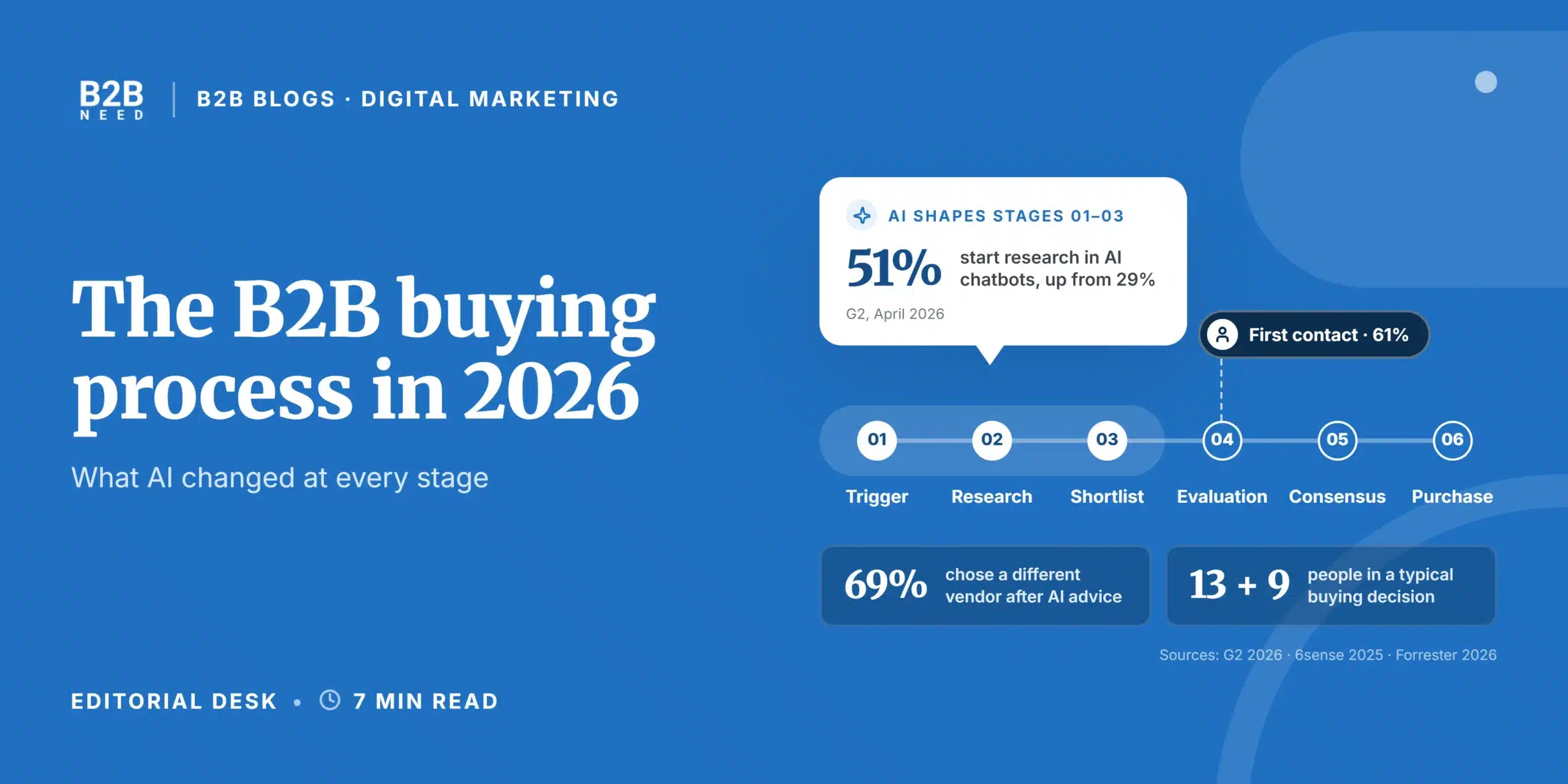
In 2026, that is increasingly an AI chatbot. G2’s April 2026 research found that 51% of B2B software buyers now start their research with an AI chatbot more often than with Google, up from 29% a year earlier. This guide walks through the B2B buying process stage by stage, shows what AI changed in each one, and sets out what marketing and sales teams should do about it.
| Quick answer: The B2B buying process has six stages: trigger, research, shortlist, evaluation, consensus and decision, then purchase and renewal. AI search now shapes the first three. Buyers ask chatbots to explain the problem, list vendors, and compare them, so many shortlists are formed before a seller is contacted. 6sense’s 2025 research found first contact happens around 61% of the way through the journey. Vendors that are absent or misdescribed in AI answers can be ruled out before they know a deal existed. |
The 2026 buyer data in one place
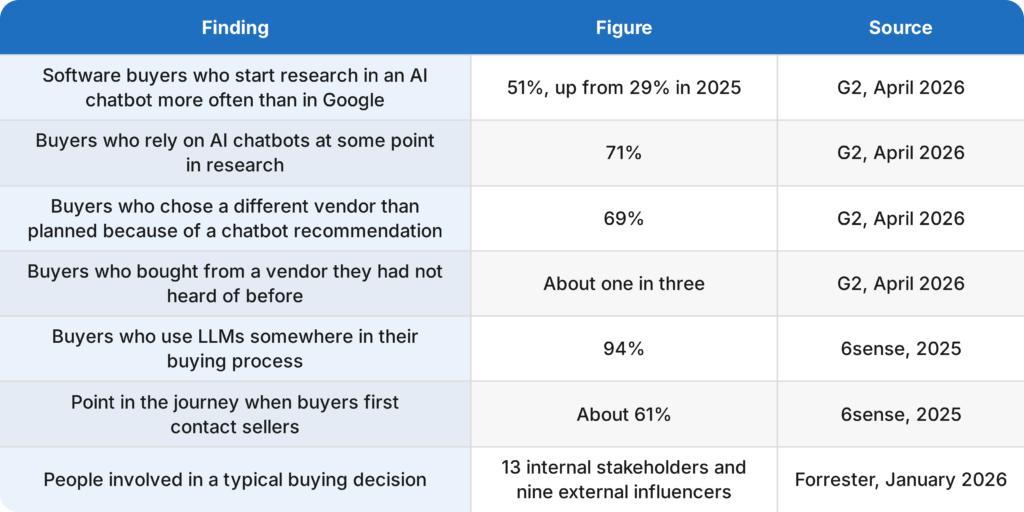
G2 surveyed 1,076 B2B software buyers in March 2026. 6sense surveyed nearly 4,000 buyers. Forrester also noted that answer engines often deliver incomplete or unreliable information, which creates mistrust, so buyers check AI answers against other sources.
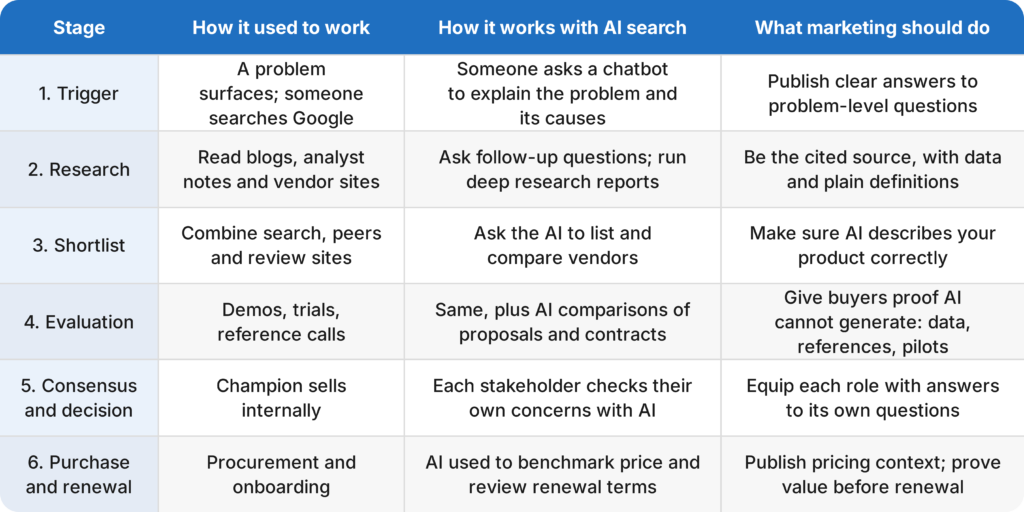
The six stages of the B2B buying process, before and after AI
Stage 1: Trigger
The buying process starts when something breaks or a goal changes: a missed target, a new regulation, a merger, or a new leader. The first question is rarely about vendors. It is “Why is our pipeline conversion dropping?” or “What does the new rule mean for us?”
What to do: publish direct, well-structured answers to the problems your product solves, not only to your product category. If a chatbot explains the problem using your framing, you are already in the conversation.
Stage 2: Research
Buyers now treat chatbots as research assistants. G2 found that 41% use deep research tools for structured software evaluations and that comparing vendor strengths and weaknesses is the top research use.
What to do: give AI systems something worth citing. That means original data, named experts, clear definitions, and pages that answer one question well. Generic content that repeats what every competitor says gives the AI no reason to mention you.
Stage 3: Shortlist
This is the stage AI changed most. G2 reports that AI chatbots are now the top source influencing which vendors make the shortlist, ahead of review sites, analyst firms, and vendor websites, and that citations from software review sites are the strongest trust signal inside AI answers.
What to do: test what AI says about you, then fix the sources it relies on. Keep review profiles current, correct outdated information on third-party sites, and publish comparison pages that state honestly who you are best for. Our article on the B2B buyer shortlist covers this stage in depth.
Stage 4: Evaluation
Once a buyer contacts you, they arrive informed and often with an AI-built comparison in hand. 6sense found that 79% of buyers initiate first contact themselves, and 62% needed sellers to answer AI-related questions during the purchase.
What to do: prepare sales teams for the questions AI raised. Give them proof that a chatbot cannot produce customer references, measured results, security documentation, and a short, well-scoped pilot.
Stage 5: Consensus and decision
With 13 internal stakeholders and nine external influencers in a typical decision, according to Forrester, your champion is not the only person asking AI about you. Finance asks about cost and risk. IT asks about security and integration. Legal asks about data protection.
What to do: map the questions each role asks and make sure a clear, accurate answer exists for each one, on your site and in the sources AI reads. Start by mapping who holds the veto in your typical buying committee.
Stage 6: Purchase and renewal
AI tools now help buyers benchmark prices, review contract terms, and prepare negotiations. At renewal, they help customers compare you against newer alternatives.
What to do: publish honest pricing context where you can and make value visible before renewal with usage and outcome reports. A customer who can show results internally is far less likely to switch after an AI comparison.
Run a prompt audit of your own buying process.
The fastest way to see where you stand is to ask the questions your buyers ask. Run each prompt in ChatGPT, Google AI Mode, and Perplexity, and record whether you appear, how you are described, and which sources are cited.
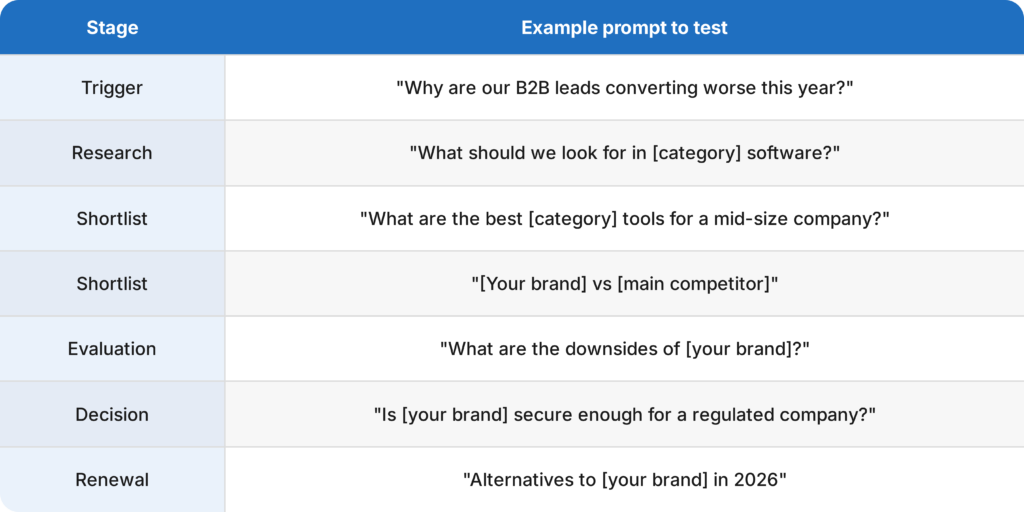
Run each prompt several times, because AI answers change between runs. MarketingBrainbox’s guide to answer engine optimization explains how to improve what the AI finds.
What this means for your demand generation plan
- Shift budget toward content that earns citations: original data, expert answers, and honest comparisons.
- Treat review sites and third-party mentions as part of your shortlist strategy, not only as social proof.
- Add a “How did you hear about us?” field and look for AI chatbots in the answers.
- Brief sales teams that buyers arrive with AI-made comparisons and prepare answers to them.
- Use intent signals to catch accounts that are researching before they contact you.
For the full planning framework, see our B2B demand generation playbook for 2027. For how AI is changing the selling side, read agentic AI in B2B sales, and for personalization with intent data, see intent data and AI personalization.
FAQs:
What are the stages of the B2B buying process?
Trigger, research, shortlist, evaluation, consensus, and decision, then purchase and renewal. Buyers often move back and forth between them.
How are B2B buyers using AI search?
They use chatbots to understand problems, research options, compare vendors, and build shortlists. G2 found 51% of software buyers now start research in a chatbot more often than on Google.
When do B2B buyers contact sellers?
6sense’s 2025 research found first contact happens around 61% of the way through the buying journey, and most buyers initiate it themselves.
How many people are involved in a B2B purchase?
Forrester’s 2026 research found a typical buying decision involves 13 internal stakeholders and nine external influencers.
How can a vendor get onto AI-generated shortlists?
Publish original, well-structured content, keep review profiles current, correct third-party information, and test regularly what AI tools say about you.
Is the B2B buyer journey the same as the B2B buying process?
They describe the same path. The buying process is the steps the organization takes; the buyer journey is how the people involved experience them.