

Most B2B demand generation plans are built for a buyer who no longer exists: someone who fills in a form, waits for a sales call, and then starts comparing vendors.
Today’s buyer does the comparing first. They research alone and with colleagues, increasingly through AI chatbots, and contact a vendor only once a shortlist is already in place. By then, most of the decision has been made.
This playbook rebuilds your B2B demand generation strategy around that reality. It is written for marketing leaders putting together their 2027 plan and budget in the next few weeks.
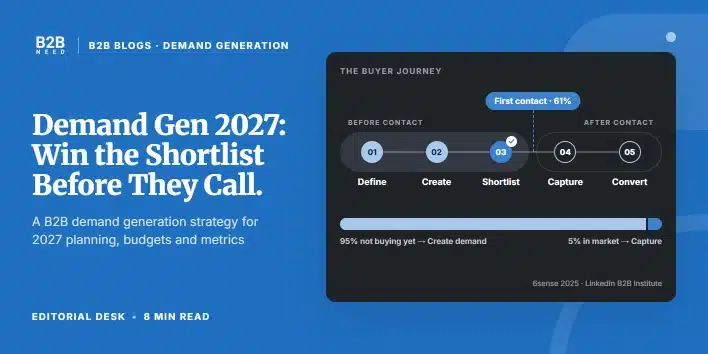
| Quick answer: A B2B demand generation strategy for 2027 has to win before buyers make contact. In 6sense’s 2025 research, buyers made first contact about 61% of the way through their journey and usually chose a vendor that was already on their day-one shortlist. A working plan splits effort between creating demand among the large majority of accounts not yet buying and capturing the few that are in market, and it reports pipeline and revenue rather than lead counts. |
Three findings that change the plan
1. The shortlist is set before you hear from the buyer.
The 6sense 2025 B2B Buyer Experience Report, based on nearly 4,000 responses, found that buyers made first contact with vendors about 61% of the way through their journey, down from 69% in 2024. Buyers started contacting themselves 79% of the time. The vendor contacted first won about 77% of the time, and the winner was on the day-one shortlist in 95% of cases.
2. Research increasingly starts in AI tools.
A G2 survey of more than 1,000 software buyers, reported in March 2026, found that 51% now start research in an AI chatbot more often than with Google. That means part of your shortlist battle now happens in answers you cannot see in your analytics.
3. Budgets are flat, and AI is taking a bigger share.
Gartner’s 2026 CMO Spend Survey of 401 marketing leaders put marketing budgets at 7.8% of company revenue in 2026, against 7.7% in 2025. CMOs allocated 15.3% of marketing budgets to AI, yet only 30% said their AI capabilities were mature. The survey covered mostly companies with revenue above $1 billion, so treat the figures as a reference point rather than a target.
Put together: you need to be known before buyers start, present where they research, and be able to prove the return on every dollar.
Demand creation and demand capture
Demand generation covers two different jobs, and most plans underfund the first.
- Demand creation builds awareness and preference among buyers who are not yet in the market. The goal is to be on the shortlist when they start.
- Demand capture converts buyers who are actively researching or evaluating. The goal is to be easy to find and easy to choose.
The reason creation matters is the 95:5 principle, popularized by the LinkedIn B2B Institute: in a typical B2B category, only around 5% of buyers are in the market at any one time. The other 95% will buy later, and the brands they remember when that moment comes are the ones that built familiarity earlier.
The five phases of a B2B demand generation strategy
Phase 1: Define the market you can win
Start with your closed-won deals from the past 18 to 24 months, not with a persona workshop. Look for patterns in industry, size, region, technology, and the trigger that started each deal. That gives you an ideal customer profile based on evidence.
Then map the buying group. Most B2B purchases involve several people, each with different questions. A finance lead wants risk and payback; an end user wants to know how daily work changes. List the roles that appear in your won deals and what each one needs to see.
Phase 2: Create demand before buyers are in the market.
This is where most of the long-term work happens. The aim is simple: when an account in your profile starts looking, your name should already be familiar.
- Publish a clear point of view on the problem you solve, and repeat it consistently.
- Build visible expertise through named people, not only the company page. Buyers often follow individual experts more closely than brands.
- Produce at least one piece of original research or data a year that others will cite.
- Run reach-focused advertising to your full account list, not only to people who visited your site.
Phase 3: Get on the day-one shortlist
Shortlists are built from what buyers find when they first look. Make sure they find you in the places that matter:
- Review sites and comparison pages for your category
- AI chatbot answers to questions such as “best [category] for [use case] “
- Analyst and media coverage
- Partner directories and communities your buyers trust
B2BNeed’s analysis of why most buyers choose a vendor already on their shortlist covers this phase in more depth.
Phase 4: Capture in-market demand
When an account starts researching, move quickly and specifically.
- Use intent signals from your own website and third-party sources to spot accounts that are actively researching. MarTechSpace compares the main intent data providers by signal source.
- Cover high-intent search terms for your category and competitors.
- Use content syndication and events to reach new buyers, with clear quality rules on who counts as a qualified lead.
- Personalize follow-up to what each account researched. B2BNeed’s guide to intent data and AI personalization covers how.
Phase 5: Convert and hand off cleanly
Buyers who reach out are often close to a decision. Slow or clumsy follow-up loses deals that marketing already won.
- Agree on a written service level with sales: response times, who follows up, and what counts as accepted.
- Hand off at account level, with the full research history attached.
- Review lost and stalled deals together every month.
How to split the 2027 budget
There is no universal split between demand creation and capture. The right balance depends on three things:
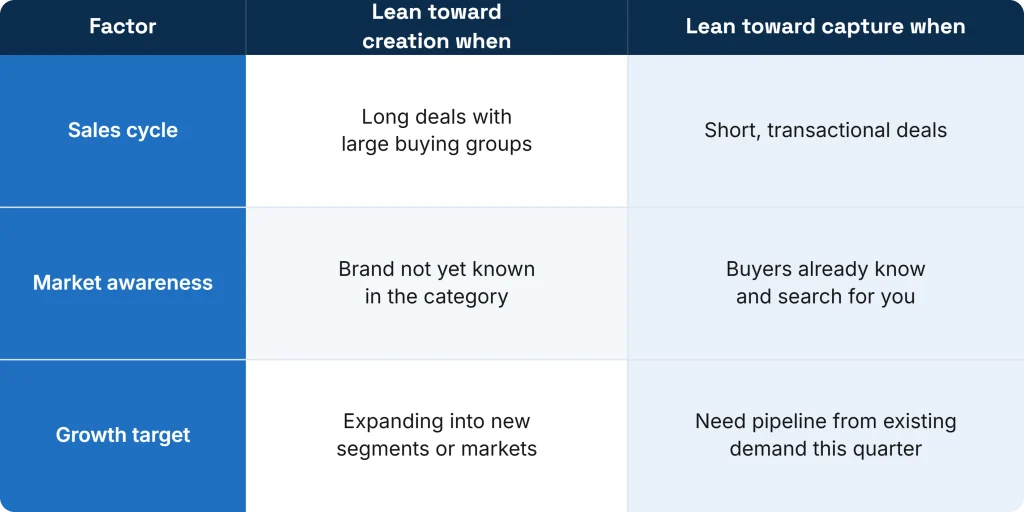
A practical method: start from your revenue target, work back to the pipeline you need using your own win rate, and fund capture to cover what current demand can realistically produce. Put the rest into creation, and protect it from being cut the moment a quarter looks tight. Write down every assumption so finance can see how the numbers were built.
Where AI fits in each phase
With 15.3% of marketing budgets already going to AI in Gartner’s survey, the useful question is where it earns its place. A practical split:
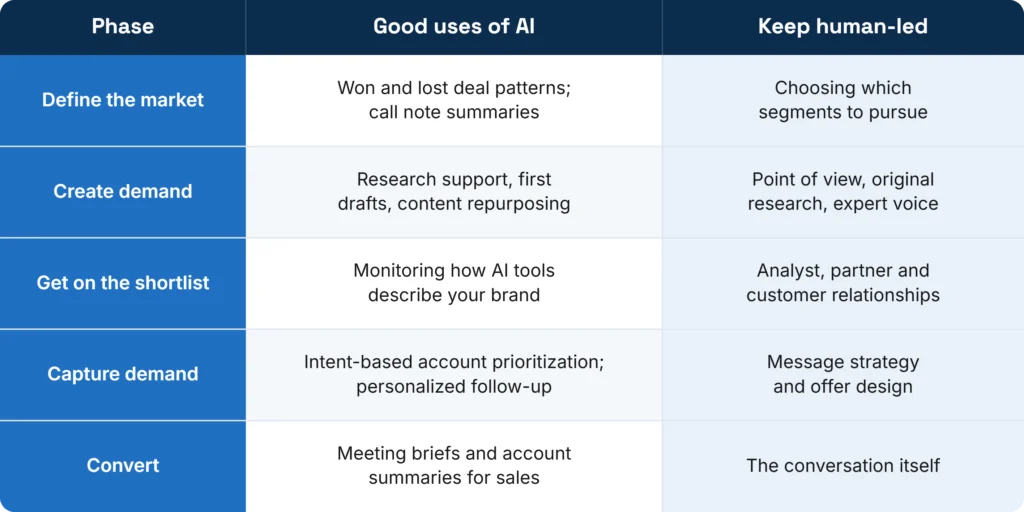
The pattern is consistent: AI speeds up research, drafting, and prioritization, while positioning, judgment, and relationships stay with people.
A quarterly operating rhythm
Annual plans fail when nobody looks at them after January. Build a simple rhythm instead:
- Monthly: review the pipeline by segment and source with sales, and fix handoff problems.
- Quarterly: check the creation and capture split against results, and move the budget where evidence supports it.
- Twice a year: refresh the ideal customer profile from new wins and lost deals.
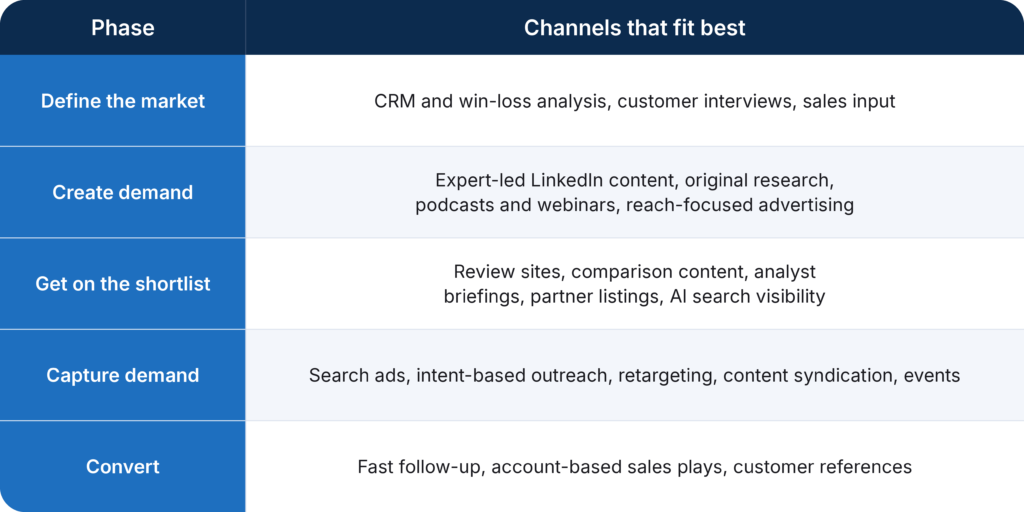
Which channels serve which phase?
Most channels can do more than one job, but each has a natural home. Use this to check that your plan covers every phase.
Common mistakes in 2027 demand generation plans
Cutting demand creation first
When a quarter looks weak, brand and thought leadership budgets are usually the first to go. The effect shows up two or three quarters later, when the shortlist forms without you.
Treating every lead the same
A webinar sign-up and a pricing page visit from a target account are different signals. Score and route them differently, or sales will stop trusting marketing’s handoffs.
Ignoring where buyers now research
If your plan has no line for review sites, comparisons, and AI search visibility, you are invisible in the places buyers use to build their shortlist.
Metrics your CFO will accept
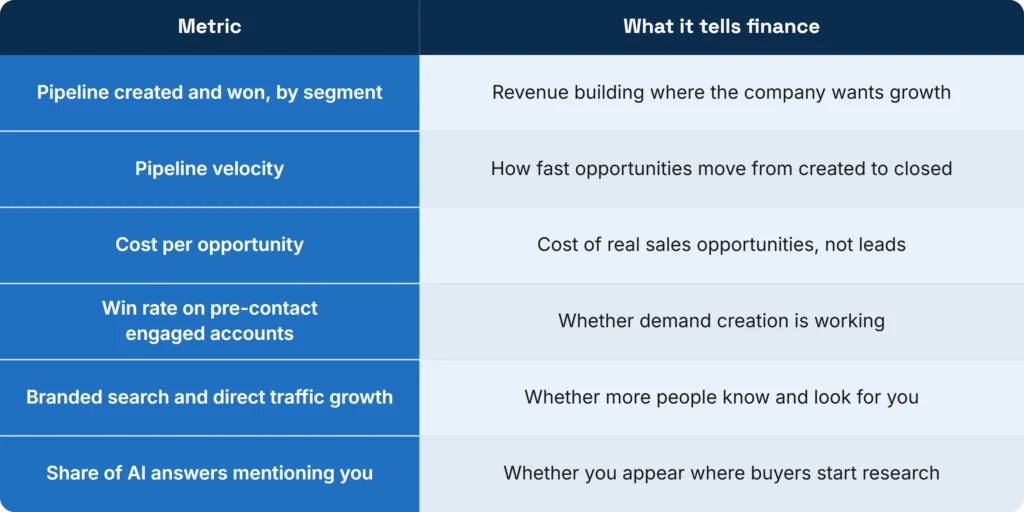
Lead volume and MQL counts often struggle to convince finance teams because they do not connect directly to revenue. Report these instead:
A one-page outline for your 2027 plan
- Revenue goal and the pipeline needed to reach it
- Ideal customer profile and buying group roles, based on won deals
- Budget split between creation and capture, with assumptions
- Channel plan by phase, with an owner for each
- Lead and account handoff rules agreed with sales
- Metrics, targets, and a monthly review date
Keep your B2B demand generation strategy to one page. If the plan cannot be explained in one page, it will not be followed past February.
FAQs:
What is the difference between demand generation and lead generation?
Lead generation collects contact details. A B2B demand generation strategy builds and converts buying interest across the whole journey and is measured by pipeline and revenue.
How much of the budget should go to demand creation?
There is no fixed figure. Companies with long sales cycles, low brand awareness, or ambitious growth targets usually need more in creation, while companies harvesting existing demand lean toward capture.
What should replace MQLs as the main metric?
The pipeline created and won by segment, pipeline velocity, cost per opportunity, and win rate are more useful to leadership than lead counts.
How do AI chatbots affect B2B demand generation?
Many buyers now begin research in AI tools, so being mentioned in those answers, on review sites, and in comparisons is part of getting onto the shortlist.
When should a 2027 B2B demand generation strategy be finished?
Ideally before budgets are set in the fourth quarter, with a quarterly review built in to adjust as results come in.